

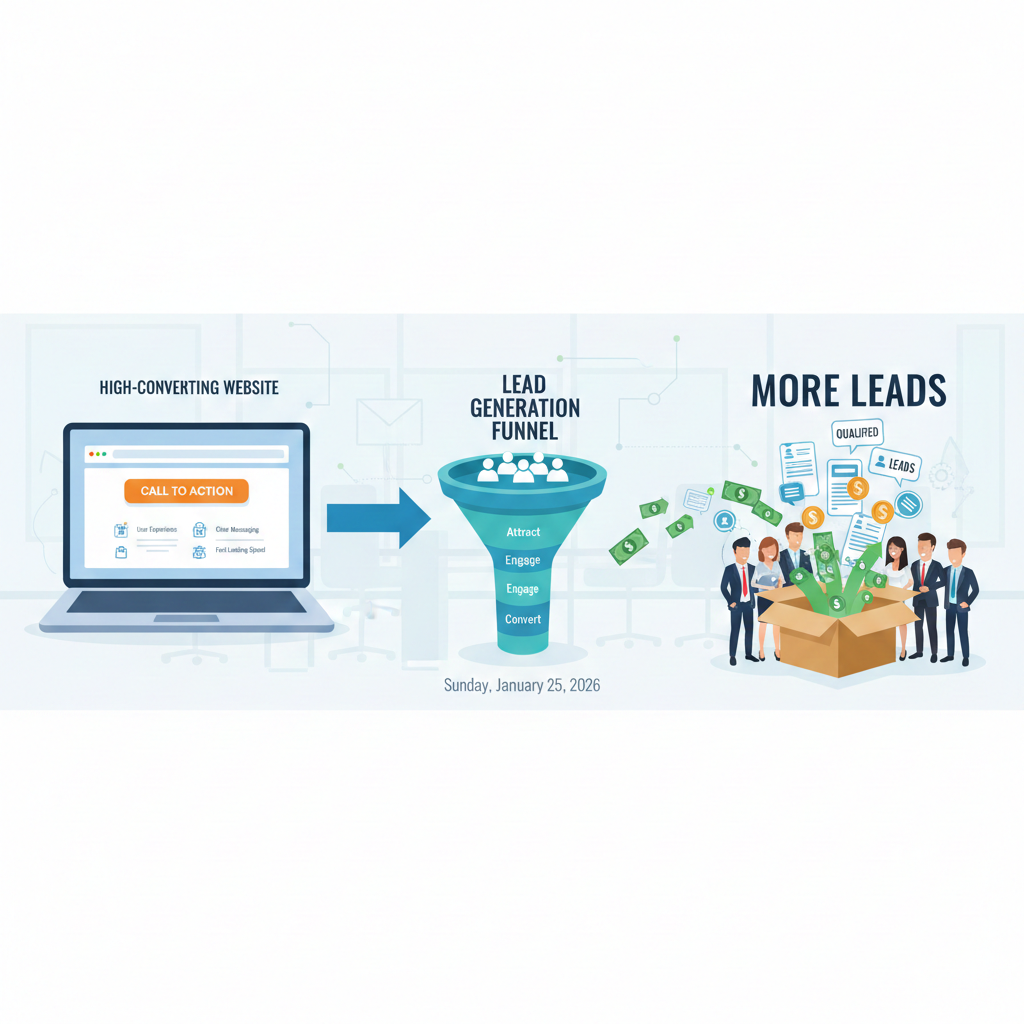
Quick Summary: In Sri Lanka's rapidly evolving digital landscape with 53.6% internet penetration and 127% mobile connectivity, a high-converting website has become essential for business success. Unlike standard websites, high-converting sites are engineered to guide visitors through a strategic funnel—from awareness to lead capture. This guide explores how Sri Lankan businesses can transform their digital presence into a 24/7 lead generation engine. We'll cover conversion mechanics, critical features, industry use cases, and why custom development integrated with POS/ERP systems delivers superior ROI. Whether you're in retail, hospitality, healthcare, or services, understanding high-converting design principles is vital for competing effectively in 2026.
Introduction
In the contemporary commercial landscape of Sri Lanka, the digital ecosystem has evolved from a peripheral marketing channel into the central nervous system of business operations. As we navigate through 2026, the distinction between "having a website" and "having a high-converting digital asset" has become the primary determinant of market leadership. For enterprises ranging from the bustling retail hubs of Pettah and Kurunegala to the burgeoning hospitality sectors in Galle and Kandy, the website is no longer merely a digital brochure; it is a sophisticated, 24/7 revenue-generating engine.
The urgency for this transformation is driven by a profound shift in consumer behavior and macroeconomic realities. Sri Lanka's digital infrastructure has matured significantly, with internet penetration rates now exceeding 53.6% of the population and mobile connectivity surging to a staggering 127% relative to the populace. This data suggests that the average Sri Lankan consumer is hyper-connected, often owning multiple devices, and their path to purchase—whether for a simple retail item or a complex B2B service—almost invariably begins with a search query.
However, a critical gap remains in the market. While digital adoption is high, digital optimization remains nascent for many businesses. Many organizations struggle with websites that are aesthetically pleasing but functionally inert. They fail to convert traffic into tangible leads due to poor user experience (UX), lack of localization, slow load times on mobile networks, or a failure to integrate with the operational backend of the business.
This report aims to bridge that gap and answer a critical question: How can Sri Lankan businesses transcend basic digital presence to build high-converting websites that actively generate qualified leads?
What Is a High-Converting Lead Generation Website?
Defining the Concept in the Context of the Digital Economy
A high-converting lead generation website is a meticulously architected digital platform designed with a singular, overarching objective: to guide a visitor from the initial stage of awareness to a specific, measurable action that qualifies them as a lead. Unlike a standard informational website, which functions as a passive repository of "About Us" content and contact details, a lead generation site is an active participant in the sales funnel. It employs the principles of Conversion Rate Optimization (CRO), behavioral psychology, and data analytics to reduce friction and incentivize engagement.
In technical terms, a high-converting website acts as a sophisticated filter. It attracts a broad audience through Search Engine Optimization (SEO) and paid media, and then uses its internal architecture to sift through this traffic, capturing the details of those with genuine intent.
The Mechanics of Conversion: How It Works
The efficacy of a high-converting website lies in its ability to orchestrate a seamless user journey. This journey is often visualized as a funnel:
1. Attraction (Top of Funnel)
The site must be discoverable. This involves technical SEO infrastructure that allows Google to index content effectively, ensuring visibility for high-intent keywords like "best POS system in Sri Lanka" or "luxury apartments Colombo."
2. Engagement (Middle of Funnel)
Once a user lands on the site, the "bounce rate" must be minimized. High-converting sites achieve this through "sticky" content—interactive elements, compelling value propositions, and localized imagery. Speed is critical here; a delay of even a few seconds can lead to abandonment on mobile connections.
3. Capture (Bottom of Funnel)
The website must present a frictionless mechanism for the user to hand over their data through a "Request a Quote" form, chatbot, or direct integration with a scheduling tool.
Real-World Scenario: Hardware Supplier in Kurunegala
Consider a hardware supplier based in Kurunegala. A contractor searches for "industrial cement prices." They land on the supplier's high-converting website. Instead of a static PDF price list, they find an interactive calculator. They input their square footage and material requirements. To see the final estimate and bulk discount, they are prompted to enter their WhatsApp number. Upon submission, two things happen instantly: the contractor receives the estimate via WhatsApp, and the supplier's sales team receives a "Hot Lead" notification in their CRM with the contractor's specific needs. This is the mechanism of a high-converting asset—it delivers value to the user while extracting value for the business simultaneously.
Who Needs a High-Converting Website?
The necessity for a high-converting website is universal across the spectrum of Sri Lankan commerce, yet the application varies by sector:
Retail and E-Commerce
With the e-commerce market in Sri Lanka projected to cross US$ 2.5 billion by 2025, retailers need sites that not only display products but manage inventory in real-time to prevent the frustration of ordering out-of-stock items.
Professional Services (Law, Finance, Consulting)
Trust is the product here. A high-converting site for these sectors uses content marketing—whitepapers, case studies, and regulatory insights—to establish authority and capture corporate leads.
Hospitality and Tourism
As tourism rebounds, hotels need websites that drive direct bookings to avoid the heavy commissions of OTAs. A conversion here is a direct reservation made on the hotel's own booking engine.
Healthcare and Pharmacies
The trend of online prescription delivery requires secure, compliant websites where patients can upload prescriptions and receive doorstep delivery.
Why High-Converting Websites Are Important for Businesses in Sri Lanka
Local Market Relevance and Digital Shifts
The Sri Lankan market is currently undergoing a unique digital metamorphosis. Following the economic recalibrations of the mid-2020s, businesses are operating in an environment where efficiency and reach are paramount. With 12.4 million internet users as of early 2025 (representing 53.6% penetration), the digital marketplace is the largest marketplace in the country. A business without a high-converting website is effectively invisible to over half the population during their buying research phase.
Statistics and Trends Driving Importance
The statistics paint a compelling picture of opportunity and competition. The digital commerce market is growing at a robust trajectory, with projections indicating a market volume of US$ 4.61 billion in 2024 alone. However, this opportunity comes with intensified competition. As more businesses come online, the "noise" increases. Users are bombarded with choices. A high-converting website is the differentiator that cuts through this noise, capturing the fleeting attention of the user and holding it.
Business Impact: Time, Cost, and Efficiency
The operational impact of a high-converting website extends far beyond marketing metrics:
- Cost Efficiency: A well-optimized website attracts organic traffic (via SEO) and converts paid traffic (via ads) at a higher rate, significantly lowering the Customer Acquisition Cost (CAC).
- Time Savings: Automated lead qualification saves thousands of man-hours. The sales team only speaks to prospects who are ready to buy.
- Operational Efficiency: When integrated with backend systems like those provided by Applantics (POS, ERP), a website reduces administrative overhead. An order placed online creates a packing slip and invoice simultaneously, eliminating manual data entry errors.
Compliance and Regional Needs: The Regulatory Landscape
In 2026, a website is also a compliance document. The enactment of the Personal Data Protection Act No. 9 of 2022 (PDPA) has placed strict obligations on how Sri Lankan businesses collect and store personal data. A high-converting website must be "compliant by design."
Key Features to Look For in a High-Converting Website
Inventory Management and Real-Time Synchronization
For any business selling physical goods, the disconnect between online and offline inventory is a major conversion killer. A high-converting website must integrate with the business's Point of Sale (POS) and Inventory Management systems. When a customer buys the last item in a physical store in Kandy, the website must instantly reflect "Out of Stock" to a user browsing in Colombo.
Reporting & Analytics
You cannot improve what you do not measure. A high-converting website is embedded with deep analytics capabilities. Integration with Google Analytics 4 (GA4), Meta Pixel, and specialized behavior tracking tools provides data on user flow—where they come from, which pages they visit, and exactly where they drop off.
Mobile & Cloud Access
The "Mobile-First" philosophy is non-negotiable in Sri Lanka. The site must adapt fluidly to any screen size. The backend must be cloud-based to ensure 99.9% uptime. Cloud hosting ensures scalability and accessibility from anywhere, allowing business owners to monitor website performance remotely.
Security & Data Protection
Security is the foundation of trust. SSL encryption, PCI DSS compliance for handling payments, and PDPA alignment with clear privacy policies are required to meet the standards and assure users that their data will not be misused.
Customization Options and UX/UI
A high-converting website is not a rigid template; it is a flexible platform. Every business is unique. A pharmacy needs a prescription upload feature; a restaurant needs a menu modifier. The website must support these custom workflows rather than forcing the business to adapt to the website's limitations.
Local Support & Training
A provider based in Sri Lanka operates in your time zone and understands the local business context. They are accountable. Effective communication is critical during troubleshooting. The provider must offer training to the client's team on how to update products, manage blogs, and interpret analytics reports.
Benefits of Using a Professional Solution
Operational Benefits
A professional solution functions as an integrated component of the business ecosystem. Leads generated on the website flow directly into a CRM, triggering automated email nurture sequences. Orders flow directly into the ERP for fulfillment. By eliminating manual data entry, the risk of human error is drastically reduced.
Financial Benefits
While the initial capital expenditure for a professional site is higher, the Return on Investment (ROI) is superior. A site optimized for conversion generates more sales from the same amount of traffic. Increasing the conversion rate from 1% to 2% effectively doubles revenue without increasing marketing spend. By automating customer service inquiries and order processing, businesses can operate with leaner teams.
Customer Experience Improvements
In a digital-first world, the website is the experience. Professional developers optimize code, compress images, and utilize Content Delivery Networks (CDNs) to ensure instant loading. Professional UX designers use data to structure information logically. A polished, professional design signals competence, making users more likely to input credit card details.
Scalability Advantages
A business is not static; it grows. A professional solution is built to scale. Professional architecture can handle spikes in traffic without crashing. As the business evolves—perhaps adding a loyalty program or expanding to international shipping—a custom professional solution can be extended.
Customized vs Ready-Made Solutions
One of the pivotal strategic decisions a Sri Lankan business owner must make is choosing between a ready-made template (SaaS platforms like Wix, Shopify, or basic WordPress themes) and a customized web solution.
| Feature | Ready-Made Solutions | Customized Solutions |
|---|---|---|
| Design Uniqueness | Generic layouts; limited branding flexibility | Unique design tailored to brand identity and local nuances |
| Performance/Speed | Often bloated; slower on mobile data | Lean, optimized code; lightning-fast performance |
| Scalability | Restricted by platform limits | Unlimited scalability; custom API integrations |
| Security | Vulnerable to widespread attacks | Hardened security; custom protocols |
| SEO Capability | Basic SEO; poor code structure | Optimized from ground up; Schema markup |
| Ownership | You rent the platform; migration difficult | You own the code; complete data sovereignty |
| Cost Structure | Low initial; high recurring fees | Higher initial; lower long-term costs |
Which Businesses Should Choose Which Option?
Choose Ready-Made: If you are a solopreneur, a hobbyist, or a micro-business testing a concept with minimal budget. If your business model is simple standard retail without complex backend needs.
Choose Customized: If you are an SME looking to scale, a specialized service provider, or a retail chain requiring inventory synchronization. If your website is a primary revenue driver and you need to build a long-term asset that integrates with systems like Applantics POS, a custom solution is the only viable path for sustainable growth.
How to Choose the Right Provider
Experience & Portfolio
Review potential providers' portfolios not just for aesthetics, but for functionality. Have they built solutions for your industry? Ask for case studies with evidence of results. Look for projects that required complex integrations (APIs, CRM connections) rather than just brochure sites.
Local Support and Presence
Digital systems require maintenance. A provider based in Sri Lanka operates in your time zone and understands the local business context. They are accountable. Can you pick up the phone and speak to a support engineer in Sinhala, Tamil, or English?
Custom Development Capability
Ensure the provider is a true developer, not just an "assembler" of templates. Ask about their tech stack. Do they use modern frameworks (React, Laravel, Node.js) or outdated CMS versions? Ask how they would handle specific custom requirements.
Transparency & Contracts
The contract should detail exactly what is included—hosting, SSL, maintenance, number of revisions. Ensure the contract states that you own the code, design, and data upon completion and payment. Clarify costs for third-party licenses, plugins, or annual renewals upfront.
Post-Launch Support
A website launch is the starting line, not the finish line. Does the provider offer a Service Level Agreement (SLA)? Will they be available to add new features six months down the line? A long-term partner is preferable to a "build and run" agency.
Why Applantics Is a Trusted Choice
In the landscape of Sri Lankan technology providers, Applantics (Pvt) Ltd distinguishes itself as more than just a web design agency; it is a full-stack software engineering firm. Based in Kurunegala but serving a national and international clientele, Applantics represents the convergence of high-level software architecture and practical business utility.
Company Background and Expertise
Applantics has established itself as a pioneer in the local tech industry, particularly known for its flagship products in the POS and ERP space. This software engineering DNA is what sets their web development services apart. Unlike design-only agencies, Applantics approaches website creation with the rigor of systems architects. They understand that a website is a database-driven application that must be secure, scalable, and robust.
Years of Experience and Local Presence
With a solid track record and a physical headquarters in Narammala, Kurunegala, Applantics offers the stability and accountability that businesses seek. They are deeply embedded in the local market, understanding the specific challenges Sri Lankan businesses face—from internet connectivity fluctuations to local payment preferences.
Unique Value Proposition
Applantics serves a diverse spectrum of clients, from individual retailers to large-scale enterprises. Their unique value proposition lies in Seamless Integration. Because they develop their own AI-powered Cloud POS and ERP systems, they can offer web solutions that integrate natively with these backend operations. They leverage Artificial Intelligence for analytics and customer interaction (chatbots), giving clients a technological edge. They offer lifetime free updates for their software products, a testament to their commitment to long-term partnership. They implement "Bank-Level Security," including PCI DSS compliance and end-to-end encryption, addressing the critical trust factor in the market.
Real-World Use Cases / Industries Served
High-converting websites are versatile tools that solve specific operational and marketing challenges across various Sri Lankan industries.
Retail and Supermarkets
The Challenge: Managing inventory across physical shelves and a digital store simultaneously.
The Solution: An Applantics-powered e-commerce site integrated with a Cloud POS.
The Result: A customer in Gampaha orders groceries online. The inventory is instantly deducted from the central warehouse database. The system generates a delivery route. The customer receives SMS updates. This unified commerce model reduces stock discrepancies to near zero and boosts customer satisfaction.
Restaurants and Cafés
The Challenge: High commissions paid to third-party delivery apps eroding margins.
The Solution: A direct-ordering website with a localized menu, KOT (Kitchen Order Ticket) integration, and payment gateway.
The Result: A café in Kandy encourages direct orders via its site. The "Click-to-WhatsApp" feature allows for order customization. The kitchen receives the order instantly on the POS. The business saves 20-30% in commissions and builds a direct customer database for loyalty marketing.
Pharmacies
The Challenge: Regulatory compliance and the need for prescription verification.
The Solution: A secure, PDPA-compliant website allowing for image uploads of prescriptions.
The Result: Patients upload their prescription securely. The pharmacist verifies it on the backend. The system sends a payment link via Genie or PayHere. The medicine is dispatched. This contactless, efficient workflow continues to drive growth.
Service Businesses (Real Estate, Consulting)
The Challenge: Generating qualified leads for high-ticket items.
The Solution: A lead-gen focused site with "gated content" and automated appointment booking.
The Result: A real estate firm uses targeted landing pages. Investors download brochures in exchange for email addresses. The CRM automatically nurtures these leads with property updates, resulting in higher conversion rates from viewing to sale.
Frequently Asked Questions
What makes a website "high-converting"?
A high-converting website is meticulously architected to guide visitors from awareness to a specific, measurable action (a lead). It employs Conversion Rate Optimization (CRO), behavioral psychology, and data analytics to minimize friction and incentivize engagement. It's not just about traffic volume, but about quality traffic and effective conversion mechanisms.
Is a custom website suitable for small businesses in Sri Lanka?
Yes. While the initial cost is higher than a template, a custom site is an asset you own. It allows for specific integrations (like local payments or WhatsApp) that are crucial for the local market, offering a better long-term ROI and avoiding monthly platform fees. Many successful small businesses in Sri Lanka have invested in custom solutions and seen significant returns.
Can the website be integrated with my existing POS system?
If you choose a provider like Applantics, deep integration is a specialty. They can connect your website to your POS/ERP, ensuring that online sales, inventory, and customer data are synchronized in real-time, eliminating manual work. This integration is particularly valuable for retail and food service businesses.
Is the solution compliant with the new Data Protection Act?
Yes, professional custom solutions are built with "Privacy by Design." This includes secure data storage, SSL encryption, and compliant cookie consent mechanisms to adhere to Sri Lanka's PDPA No. 9 of 2022. Compliance is not an afterthought but integral to the architecture.
How long does implementation take?
Timelines vary by complexity. A standard lead generation site might take 4-6 weeks. A fully integrated e-commerce ecosystem with custom POS connections typically takes 8-12 weeks to ensure rigorous testing and security auditing. The exact timeline depends on your specific requirements and feature complexity.
Conclusion & Call to Action
As we look toward the horizon of 2026, the mandate for Sri Lankan businesses is clear: digital transformation is no longer an option, but a survival strategy. A high-converting website is the cornerstone of this strategy. It is the bridge that connects a brand to the millions of digital-native consumers on the island. It is the tool that converts passive traffic into active revenue, and casual browsers into loyal advocates.
The choice between a generic, template-based presence and a custom-engineered, integrated solution is a choice between stagnation and growth. Businesses that leverage data, integrate their operations, and prioritize user experience will define the future of the Sri Lankan economy.
Summary of Value
- 24/7 Lead Generation: Your website works while you sleep
- Operational Efficiency: Integration with POS/ERP saves time and money
- Brand Authority: A professional digital presence builds trust in a competitive market
- Compliance & Security: Protect your business and your customers with robust, compliant systems
Ready to Transform Your Digital Presence?
Partnering with a proven expert like Applantics ensures that you are not just building a website, but an integrated digital business engine, backed by years of experience and local expertise.
Contact Applantics Today
Ready to accelerate your growth with a high-converting website? Get in touch with our team for a comprehensive consultation.
Visit Us: Narammala, Kurunegala, Sri Lanka
Call Us: +94 70 524 3021
Email: admin@possystem.lk | support@applantics.com
Website: possystem.lk