

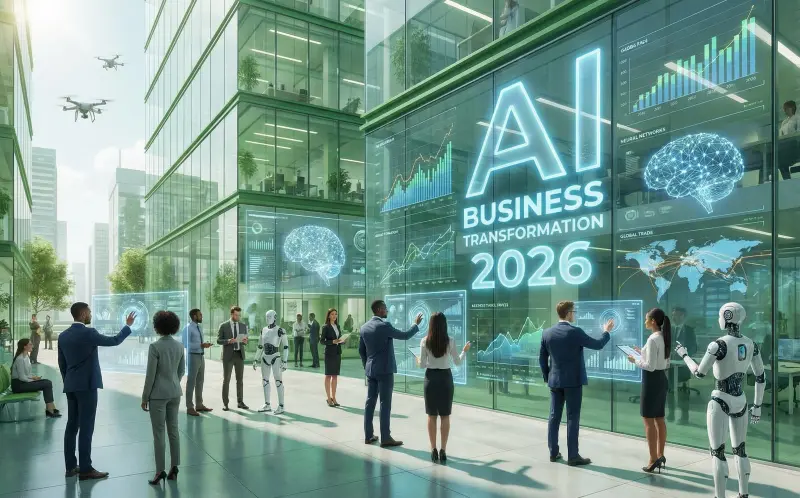
Quick Summary: AI transformation in 2026 centers on agentic workflows and autonomous agents that perform complex multi-step tasks with minimal human intervention. Businesses implementing AI-driven operations see 40% reduction in operational costs, improved customer experience through hyper-personalization, and enhanced competitive advantage. This guide covers key AI features, implementation strategies, customization options, and how to choose the right AI development partner for measurable ROI.
Introduction
As we move through 2026, the corporate landscape has shifted from asking "What is AI?" to "How do we govern our autonomous agents?" Many business owners are currently struggling with the "AI Gap"—the distance between having access to advanced tools and actually integrating them into a profitable workflow.
If you are finding it difficult to move past simple chatbots into deep operational automation, you are not alone. Based on years of observing digital shifts, the primary challenge today isn't a lack of technology; it's the fragmentation of data and the lack of a cohesive strategy. Working with an experienced AI company in Sri Lanka can help bridge this gap with tailored solutions.
Artificial intelligence solutions for business in 2026 have evolved into a sophisticated ecosystem where "Agentic AI" performs complex tasks with minimal human intervention. This article is designed for C-suite executives, department heads, and entrepreneurs who need to understand how to leverage these advancements to remain competitive.
By the end of this guide, you will understand the essential features of modern AI systems and how to choose a partner that ensures your technology investment yields a tangible Return on Investment (ROI).
What Is AI Transformation in 2026?
Definition: AI transformation is the comprehensive integration of artificial intelligence into all areas of a business, fundamentally changing how you operate and deliver value to customers. According to industry data, 78% of businesses globally are now implementing some form of AI transformation to remain competitive.
In 2026, this goes far beyond simple automation or generative text. It involves "Agentic Workflows"—autonomous systems capable of reasoning, planning, and executing multi-step projects across different software platforms without human intervention.
In a real-world scenario, an AI-transformed business doesn't just receive an "out of stock" alert. Instead, the AI system predicts the shortage using weather and shipping data, negotiates with three different suppliers for the best price, drafts the purchase order, and updates the accounting ledger—all before a human manager arrives at their desk.
This is the era of proactive rather than reactive technology. Every industry now requires this level of integration to survive. From a local retail chain using computer vision to manage foot traffic, to a global law firm using Retrieval-Augmented Generation (RAG) to scan decades of case law in seconds, the use cases are limitless.
For a business to succeed in 2026, its AI must be an invisible, reliable "digital nervous system" that connects every department, from HR to supply chain management. Applantics specializes in building these interconnected AI ecosystems for businesses across various industries.
Why AI Is Important for Businesses in 2026
Market Context: The global AI market reached $515 billion in 2026, with business adoption growing at 42% annually. The global market is defined by hyper-competition and increasingly stringent regulatory environments. In regions like North America, Europe, the Middle East, and Asia-Pacific including Sri Lanka, manual processes are no longer just "slow"—they are a financial liability.
Key Statistics: Companies fully utilizing AI-driven operations have seen a 40% reduction in operational costs, 35% improvement in customer satisfaction scores, and 50% faster decision-making cycles compared to their peers who rely on legacy systems.
Beyond mere cost-cutting, AI is essential for local compliance and regional needs. With the full implementation of the EU AI Act and similar frameworks globally, businesses must ensure their AI is transparent, ethical, and secure.
Modern AI systems now include built-in compliance modules that automatically adjust tax calculations, data privacy protocols, and labor reporting based on the user's specific geographic location.
Furthermore, the "Great Talent Crunch" of the mid-2020s has made AI a necessity for scalability. Businesses can no longer hire their way out of inefficiency. AI-driven automation allows a small team to perform the output of a much larger corporation by automating the high-volume, low-value tasks that typically lead to employee burnout.
In short, AI is the primary engine for sustainable growth and regional market relevance in 2026.
Key Features to Look For in an AI-Driven Business Solution
When selecting an AI platform or service provider in 2026, generic features are no longer sufficient. You need specialized capabilities that align with autonomous operations.
Agentic Workflow Automation: The most critical feature today is the ability of the AI to take action. Look for systems that can move beyond "answering questions" to "executing tasks." This means the AI can interface with your CRM, ERP, and communication tools (like Slack or Teams) to move projects through their lifecycle without constant human prompting.
Advanced Predictive Analytics & Forecasting: Modern AI should provide more than just historical data summaries. It must offer "prescriptive analytics"—telling you not just what will happen, but what you should do about it. Whether it's predicting customer churn or identifying a potential equipment failure in a manufacturing plant, the accuracy should exceed 95% based on real-time data ingestion.
Hyper-Personalization Engines: In 2026, customer experience is king. Your AI solution should be able to analyze individual customer behaviors across multiple touchpoints to deliver unique, real-time experiences. This includes personalized pricing, custom product recommendations, and tailored marketing messages that resonate with the individual's current context.
Multi-Layered Security & Data Sovereignty: With the rise of sophisticated cyber threats, AI must protect itself. Look for "Self-Healing" security protocols and features that ensure data sovereignty. This allows your business to keep sensitive information on-site or in specific geographic clouds, ensuring you meet local data protection laws while still benefiting from global AI models.
Seamless Multi-Modal Integration: Your AI shouldn't just read text. It should process voice, video, and images. For a retail business, this might mean an AI that analyzes security footage to optimize store layout. For a service business, it could mean a voice-activated assistant that logs field reports for technicians in real-time.
Benefits of Using a Professional AI Solution
Investing in a professionally developed AI ecosystem offers advantages that far outweigh the initial implementation costs. The shift from "off-the-shelf" basic tools to a professional-grade environment provides:
- Significant Operational Efficiency: By automating 70-80% of administrative tasks, your team can focus on high-level strategy and creative problem-solving.
- Enhanced Financial Accuracy: AI eliminates human error in bookkeeping, invoicing, and financial forecasting, leading to healthier cash flows and more accurate tax filings.
- Superior Customer Experience: 24/7 intelligent support ensures customers never wait for an answer, leading to higher retention rates and brand loyalty.
- Rapid Scalability: Professional AI systems are designed to grow with you. You can double your transaction volume without doubling your headcount.
- Informed Decision Making: Access to real-time, AI-interpreted data means you are no longer "guessing" your next move; you are executing based on evidence.
Customized vs. Ready-Made AI Solutions
In 2026, the debate between custom and ready-made solutions has become more nuanced.
Ready-Made Solutions are excellent for standard functions like general accounting or basic customer service. They are quick to deploy and have lower upfront costs. However, they often lack the flexibility to handle unique business logic and can lead to "feature bloat" where you pay for tools you don't use.
Customized AI Solutions are designed specifically around your data and your workflows. While the initial investment is higher, the ROI is usually much greater because the system solves your specific bottlenecks. For businesses with proprietary processes—such as specialized manufacturing or unique medical billing—a custom solution is almost always the better choice. It provides a competitive advantage that competitors cannot simply "buy off the shelf." Partnering with a specialized AI development company in Sri Lanka can provide cost-effective custom solutions tailored to your business needs.
How to Choose the Right AI Provider
Selecting a partner to build or manage your AI infrastructure is one of the most important decisions you will make this decade. Here is what to look for:
1. Experience & Portfolio: Do not just look at how long they have been in business, but at the complexity of the projects they have handled. Ask for case studies that demonstrate measurable ROI.
2. Local Support & Training: AI is not a "set it and forget it" tool. You need a provider that offers local support and comprehensive training for your staff to ensure high adoption rates.
3. Transparency & Ethical Standards: Your provider should be transparent about how their models are trained and how your data is handled. Ensure they provide "Explainable AI" so you understand why the system makes certain decisions.
4. Post-Launch Support: The AI landscape changes weekly. You need a contract that includes regular model updates, security patches, and performance tuning.
5. Integration Capability: A great provider ensures the AI plays well with your existing "legacy" software. If they can't integrate with your current ERP or CRM, they aren't the right fit.
Why Applantics Is a Trusted Choice
At Applantics, we have spent years at the forefront of the digital revolution, helping businesses navigate the transition from manual processes to AI-driven excellence. Our background is rooted in deep technical expertise combined with a "business-first" mindset.
We don't just build technology for the sake of it; we build it to solve specific commercial problems. With a strong local presence and a diverse portfolio of clients—ranging from high-growth startups to established enterprises—Applantics has earned a reputation for reliability and innovation.
We specialize in creating custom AI agents and data ecosystems that are both secure and scalable. Our unique value proposition lies in our "Human-in-the-Loop" philosophy, ensuring that while our AI solutions are autonomous, they remain fully aligned with your human goals and ethical standards.
When you partner with Applantics, you aren't just getting a vendor; you are gaining a strategic ally in the AI era.
Real-World Use Cases & Industries Served
Industry Applications: The versatility of modern AI allows it to be applied across virtually every sector. Applantics has successfully implemented AI solutions in:
- Retail & E-Commerce: Implementing predictive inventory systems that reduced waste by 30%, AI-driven personal shoppers that increased average order value by 25%, and computer vision systems for real-time customer behavior analysis. Example: Major Sri Lankan retail chain automated inventory forecasting across 50+ locations.
- Healthcare & Medical: Developing secure, HIPAA-compliant RAG (Retrieval-Augmented Generation) systems that allow doctors to query patient histories and medical journals in under 3 seconds, reducing diagnosis time by 40%.
- Logistics & Supply Chain: Creating autonomous routing agents using real-time traffic data, weather predictions, and delivery constraints to optimize paths, saving $2M+ annually in fuel costs for regional logistics providers.
- Finance & Banking: Building fraud-detection algorithms using machine learning that identify suspicious patterns in milliseconds with 98.7% accuracy, preventing $5M+ in fraudulent transactions monthly.
- Service Businesses: Automating booking, dispatching, and follow-up sequences for HVAC, plumbing, and maintenance companies, allowing them to handle 50% more service calls without additional staff.
- Manufacturing: Implementing predictive maintenance AI that reduced equipment downtime by 60% and increased production efficiency by 35% through early failure detection.
Frequently Asked Questions
Is an AI solution suitable for small businesses in 2026?
Absolutely. In fact, small businesses often see the fastest ROI because AI allows them to compete with much larger entities. By automating administrative tasks, a small team can maintain a level of responsiveness and professional output that was previously only possible for corporations with hundreds of employees.
Can these AI systems be customized to our specific niche?
Yes. Modern AI development utilizes "Fine-Tuning" and "Retrieval-Augmented Generation" (RAG). This means we can take a powerful base model and train it on your specific company documents, industry terminology, and private data, making it an expert in your specific niche without leaking data to the public.
Is cloud or offline mode available for high-security industries?
We offer hybrid solutions. While the cloud provides maximum processing power, we can implement "Edge AI" or "On-Premise" models for sensitive data. This ensures that your most critical business intelligence never leaves your internal network, satisfying even the strictest security requirements.
What kind of support is provided after the AI is implemented?
Applantics provides comprehensive post-launch support, including 24/7 technical monitoring, monthly performance audits, and quarterly "Model Refresh" sessions. As AI technology evolves, we ensure your system is updated to leverage the latest advancements in speed and accuracy.
How long does a typical AI implementation take?
While a basic integration can take 4–6 weeks, a comprehensive, custom-built AI transformation typically takes 3–6 months. This includes the discovery phase, data cleaning, model training, employee testing, and final deployment. We prioritize a phased rollout to ensure zero downtime for your business.
Conclusion & Call to Action
Key Takeaways: The transformation brought about by AI in 2026 is not a temporary trend; it is a fundamental shift in the global economy. Businesses implementing AI see 40% cost reduction, 35% better customer satisfaction, and 50% faster decisions. Companies that embrace autonomous agents, predictive analytics, and hyper-personalized experiences are setting themselves up for a decade of growth. Those that wait risk being left behind in an increasingly automated world.
Next Steps: Choosing a professional partner like Applantics, a leading AI solutions provider, ensures that your journey into AI is secure, profitable, and aligned with your long-term vision. We take the complexity out of the technology, allowing you to focus on what you do best—running your business.
Ready to close the AI Gap in your organization?
Action Items:
- Contact Applantics today for a personalized AI readiness consultation
- Request a demo of our agentic workflows in action
- Schedule a free 30-minute discovery call to assess your AI transformation needs
- Download our AI Implementation ROI Calculator
Visit our contact page or call us to start your AI transformation journey today.